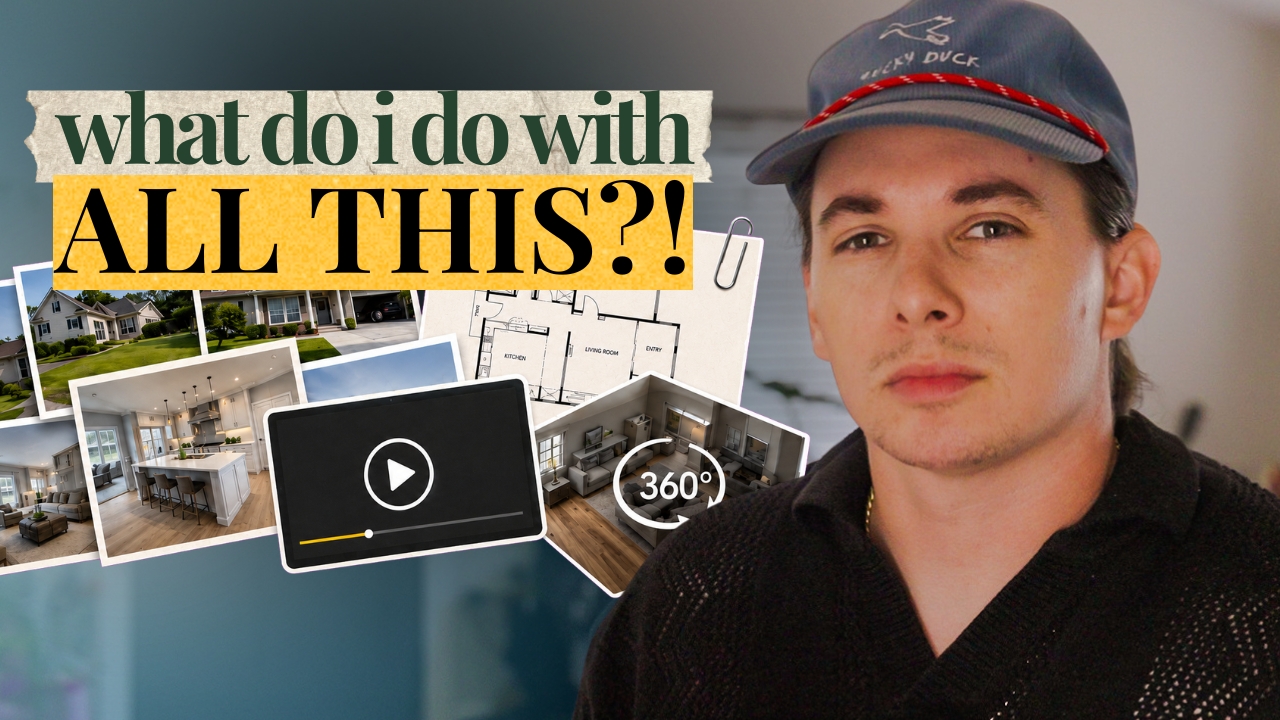
The other day, I delivered a complete real estate media package to a client.
Photos. Videos. A 3D tour. Floor plans. A property website. Everything.
She looked through it and said:
“This is great—but what do I do with all of it?”
That question immediately made me realize two things:
First, I had made a mistake.
Second, I completely understood why she felt overwhelmed.
From my perspective, I had delivered a ton of value. From her perspective, I had handed her a collection of marketing tools without explaining where any of them belonged.
The problem wasn’t that the media was bad or that the package included the wrong deliverables.
The problem was that I expected the media to explain itself.
More Media Doesn’t Automatically Mean More Value
As real estate photographers, we naturally think about the quality and quantity of what we deliver.
We offer photos, drone coverage, cinematic videos, vertical videos, floor plans, 3D tours, virtual staging and property websites. When we combine several of those services into one package, it feels like we’re giving the agent everything they could possibly need.
But giving an agent more media isn’t necessarily the same as giving them more value.
If the agent doesn’t understand what each asset is for, where to publish it or how it fits into the overall marketing strategy, the package can quickly become overwhelming.
This made me reconsider what it really means to be a real estate media partner.
I don’t want to simply take an order, show up and complete whichever boxes were checked during booking. I want to understand the property well enough to help create something that actually works for it.
I’m not perfect at this. I don’t always ask the right questions, and sometimes I move too quickly because I assume the agent already has a plan.
Then I find out later that they were looking to me for direction.
The Agent Is the Hero
There’s a common marketing principle that says the customer should be the hero and the business should be the guide.
That might sound a little “marketing guru,” but it makes sense in this industry.
The agent won the listing. They made promises to the seller. Their name is on the sign, and their reputation is attached to how the property is presented.
If the listing sits on the market for three months, the seller usually isn’t calling the photographer. They’re calling the agent.
Even though I’m the person walking through the house with the cameras, deciding on the angles and determining how the property should look, I’m supporting a much larger job.
My goal shouldn’t always be to turn every house into the biggest portfolio piece I’ve ever created. My goal should be to help the agent market that specific property in the way that makes the most sense.
Every Property Doesn’t Need the Same Package
A cinematic video might make sense when a home has a strong story, an incredible view or a lifestyle worth selling emotionally.
Drone photography might be essential when the location is a major selling point, the property lines are unusual or the land is too large to understand from the ground.
A high-quality 3D tour might be valuable when the layout or the way sunlight moves through the home is part of the experience.
A smaller, straightforward listing may not need all of those things.
The value of being a media partner isn’t always convincing the agent to purchase more. It’s being able to explain why a particular service belongs in the package—or why it doesn’t.
The media should fit the strategy.
Otherwise, we’re adding products simply because they exist and creating packages that are expensive, confusing and disconnected from what the agent is actually trying to accomplish.
Stop Treating the Booking Like a Fast-Food Order
I’m trying to stop thinking of booking as simply receiving instructions.
This isn’t McDonald’s.
A completely automated ordering process may be efficient, but it doesn’t necessarily build a relationship or demonstrate your full value.
That doesn’t mean every listing needs an hour-long consultation covering every service you offer. It could be as simple as asking a few basic questions:
- What makes this property different?
- Who is the likely buyer?
- What does the seller expect from the marketing?
- Where will the agent promote the listing?
- Is the goal only to sell this home, or also to help the agent win future listings?
- Which two services would have the greatest impact?
Maybe the agent is focused on Instagram, in which case vertical cinematic content could be more valuable than a traditional horizontal luxury video.
Maybe the agent wants to impress the seller and use the listing as proof of what they can offer future clients.
Those are different goals, and they may require different media.
Explain How Every Deliverable Should Be Used
The strategy shouldn’t end after the agent chooses a package.
We should also explain how the finished media can be used once it’s delivered.
A complete platform like Giraffe360 can provide the agent with a 3D tour, floor plan, property website, marketing videos and other assets. If professional photos were also captured, those may be included alongside everything else.
That sounds incredibly valuable—and it is—but the agent may still have basic questions:
- How do I download everything?
- Which assets belong on the MLS?
- What should I post on social media?
- Where do I share the property website?
- Should I upload the video to YouTube?
- Can I send the video to the seller?
- Which link should I send to prospective buyers?
The solution doesn’t need to be a giant instruction manual.
A simple delivery guide, short walkthrough video or templated email could give the agent enough direction to confidently use what we created.
Even an asset that isn’t used publicly can still have value. For example, the property website could be sent directly to the seller as proof of everything the agent is doing to market the home.
Some media markets the property. Some media markets the agent.
The strongest packages often accomplish both.
Real Estate Agents Are Looking for Solutions
Virtual staging is a good example of the difference between offering a service and offering a solution.
I don’t personally create virtual staging images myself. I work with other people who handle that part of the process.
When an agent asks me whether I offer virtual staging, I don’t tell them to Google a company and figure it out themselves. I tell them that I have someone who can do it, explain the price and show them the available styles.
Could the agent find a virtual staging company on their own?
Absolutely.
But the value I provide is removing another task from their plate.
That same thinking can apply to nearly every part of the listing. The photographer doesn’t have to personally perform every service, but a valuable media partner should know how to help the agent find a solution.
Follow Up After Delivery
I never would have known my client felt overwhelmed if I hadn’t continued talking with her after delivering the package.
Following up is something I still need to improve.
It can be as simple as asking:
- Did you have any trouble downloading the media?
- Do you know where everything should be posted?
- Is there anything you haven’t been able to use?
- Did the seller have any questions?
- Is there anything we should do differently next time?
That follow-up should probably become an automatic part of the process.
It helps the agent get more value out of what they purchased, gives me feedback that can improve future packages and changes the nature of the relationship.
Instead of contacting the agent only when they want another shoot, I’m checking in to make sure the work actually helped them.
That’s a completely different conversation—and it gives me real information I can use when another client asks what their listing needs.
Become the Guide, Not Just the Person Holding the Camera
What real estate agents ultimately want is someone who can look at a property, understand the goal and help shape a media package that makes sense.
That doesn’t mean taking control away from the agent.
It means being able to say:
“I have cameras, a drone, microphones, 3D tours, property websites, floor plans and virtual staging. Based on this property and what you’re trying to accomplish, here’s what I think you need.”
That is what it means to become a genuine media partner.
Whatever camera, equipment or platform you use, remember this:
Giving an agent more stuff is not the same as giving them a better plan.
Our job is to help make the media make sense.
You can also get 10% off Giraffe360 with code COLECONNOR.

- How to Build Real Estate Photography Packages That Sell - August 25, 2026
- The Best Drone for Real Estate Photo & Video - August 6, 2026
- What Real Estate Agents Want in a Media Partner - July 30, 2026